I’d love to hear from you — whether you have a project in mind, or just want to connect.
reneelkennedy@outlook.com

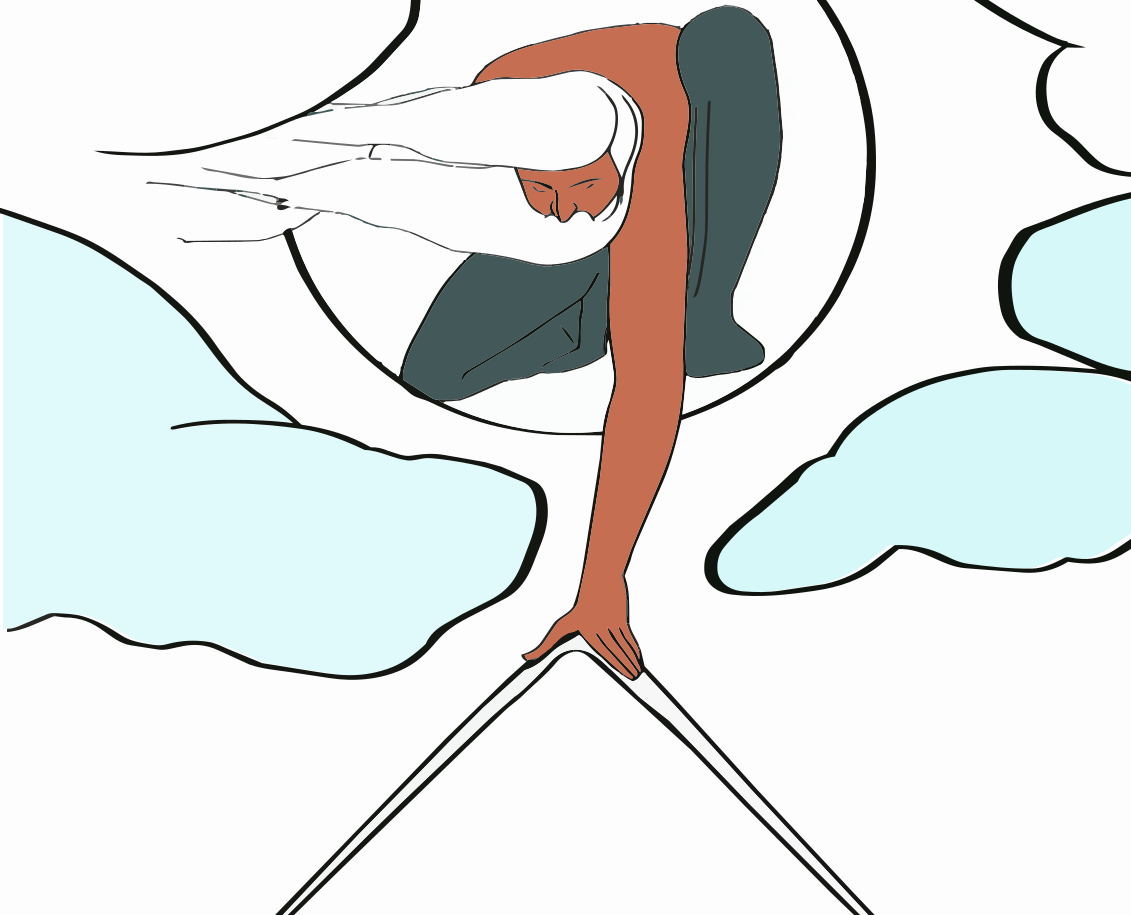
I’ve been trained in AI for UX, and it’s woven into nearly every part of my design practice: research, synthesis, ideation, writing, prototyping, testing, exploration, and increasingly, building. If AI can do something well, I want to know how to put it to work. This isn’t a skeptic’s take. I’m in there, working with it. And honestly? I love having it.
To anyone still worried that AI will reduce the need for designers: from where I sit, it’s the opposite. The more sophisticated AI tools get, the more we need designers who know how to direct them: when to let AI run, when to rein it in, and when to say enough.
AI can make an astonishing number of things (screens, code, interactions, architectures, content, variations) faster than any of us could make them by hand. AI is not taking the design work. It's taking away the work that got in the way of designing. But when a machine can make just about anything, someone has to make sure all those things still belong together.
That's our job.
For the first time in my career, I can have an idea in the morning and see it working by the afternoon. Not polished, not ready to ship, but real enough to share and test. That's a huge change. For years, we spent an enormous amount of time translating ideas into artifacts (screens, components, prototypes, flows) just so we could see and share what we were thinking.
Now, with some wise prompting (that's a future post!), I can have AI build my ideas and spin up several variations in no time. I can ask, “What happens if the user does this, or that?” I can play out edge cases and push a feature hard to see where it breaks. It's like suddenly having a lot of extra hands, and I’m thrilled to have them. The cost of exploring has basically collapsed.
But there's a catch.
AI can make a gorgeous screen that doesn't belong in the product. It can solve a problem that wasn't actually the problem, or add a feature that makes sense on its own but creates a mess somewhere else. It can carry one wrong assumption through an entire experience without ever noticing. And because each piece looks reasonable on its own, the problem isn't always obvious. The picture can fall apart one perfectly plausible decision at a time.
That's where we come in. We're not just evaluating screens. We're responsible for whether the entire journey actually works, from A to Z, including the ugly parts that never make it into the portfolio. What happens when someone makes a mistake? What happens when they don't have the information we assumed they'd have? What happens when they arrive from somewhere we didn't plan for, or need to go back a step, or leave halfway through and return tomorrow? What happens six months from now, when another feature gets added right next to this one? A single screen can look perfect and still fail every one of those tests. The journey is where a design either holds together or quietly doesn't.
And it goes deeper than the flow. AI doesn't just generate layouts; it generates the content and assumptions underneath them, and it's remarkably confident about both. When there's a hole in the picture, it will happily fill it with something plausible, like a statistic, a user need, a policy, or a behavior, that simply isn't true. It won't flag it. It'll just make it look finished. So part of our job now is questioning whether the foundation is trustworthy, not just whether the surface is coherent. A polished interface built on a false assumption is still a bad design. Arguably a worse one, because it's so convincing.
One of the biggest differences between working with AI and working with another designer is that AI doesn't know when you've wandered off course. It follows the conversation wherever it goes, and it's risky precisely because it's so good at being helpful.
You ask it to solve one problem. It notices another, so you fix that too, which opens up something else worth improving. Before long you're redesigning the navigation, adding personalization, and building a feature that was never in the brief, and every step along the way sounded perfectly sensible. That's the weeds.
This is where experience earns its keep. A senior designer learns to notice when exploration is turning into scope creep, when a solution adds more complexity than it removes, and when the work is getting more sophisticated without getting more useful. At some point somebody has to say stop. Not because the idea is bad, but because it's not where we're going.
We do.
So I keep checking my position. Are we still focused on solving the right problem? Is the work still serving the user? Are we making decisions based on evidence, or are we allowing AI-generated plausibility to become our evidence? Did we discover something important, or just something interesting?
The question I keep coming back to is this one: are we getting closer, or are we just getting busier? AI can make us incredibly productive at heading in the wrong direction.
This is where senior design becomes less about production and more about stewardship. AI doesn't eliminate the need for judgment. It increases the number of moments when judgment is required.
In practice, that means questioning what AI tells us instead of trusting it because it sounds confident, looking for bias, and checking the entire journey rather than celebrating one great output. It means building guardrails, like skills that encode our standards and known blind spots, so AI follows our rules instead of guessing. And it always means including a human audit.
It also means holding a point of view, because AI won't. Push back even vaguely and it often folds instantly: "You're right, that wasn't a good direction," sometimes without knowing which piece you meant. AI is a people-pleaser. We must hold the lead.
And it means asking not just whether the thing can be built, but whether it can be built upon. Will the architecture hold up six months from now? Are we making a coherent system or a pile of one-offs? We're not just designing today's experience; we're setting up tomorrow's.
So I don't want to compete with AI at making artifacts. Let it build the first version, the variations, the code, the edge-case prototype. Then I'll do the part I actually became a senior designer to do: look at the whole system, connect the dots, question the assumptions, spot the contradictions, and decide what doesn't belong.
The machine can keep generating possibilities forever. It doesn't get tired, and it doesn't notice when the product has drifted somewhere it was never supposed to go. It has a habit of sending you on tangents, like that colleague who catches you by the water cooler and suddenly you're in some bizarre conversation you're not sure how to get out of. One interesting idea leads to another, and before you know it, you've drifted a long way from the original direction. It also wouldn't care if it burned through my credits on changes that aren't getting us anywhere. It's on me to stay diligent and centered, ready to say, "Okay, that's enough. We're going this way."
That's the partnership as I see it. AI is a remarkable coworker: fast, tireless, and full of ideas. But it has a bad memory for nuance. It can forget the subtle decisions that have accumulated throughout the work: the tone, the sharpness of an idea, the reason we rejected something three iterations ago. Then it drifts back toward a formula that loses what was distinctly ours.
AI can lose the plot. I keep it.
Speed only matters when it's heading somewhere worth going. AI gives us velocity. We give it direction.
Bottom line: AI is a massive leap in what we can build, test, and iterate, but the vision and the integrity of the work are still ours to protect.